

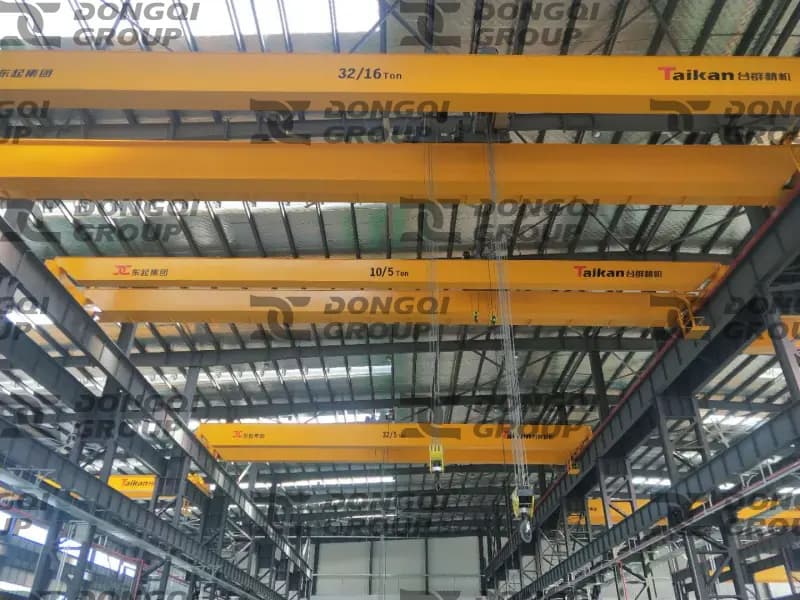
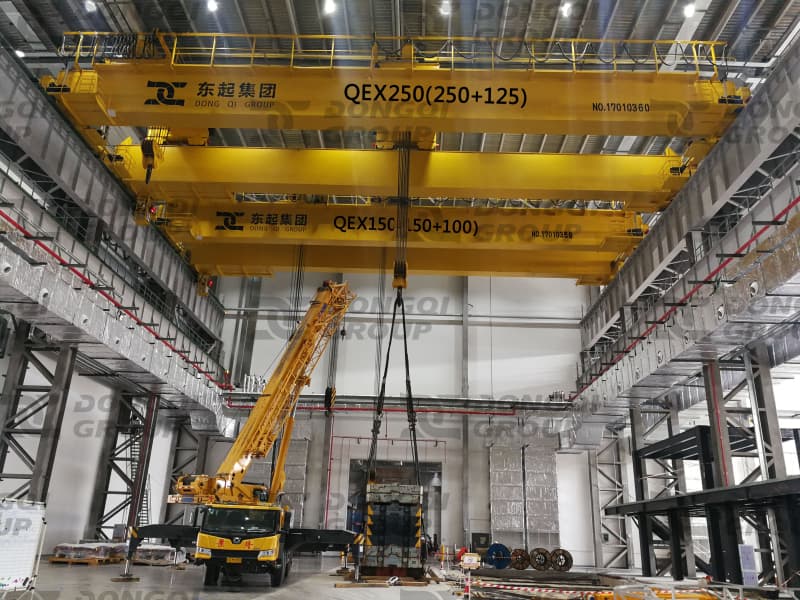
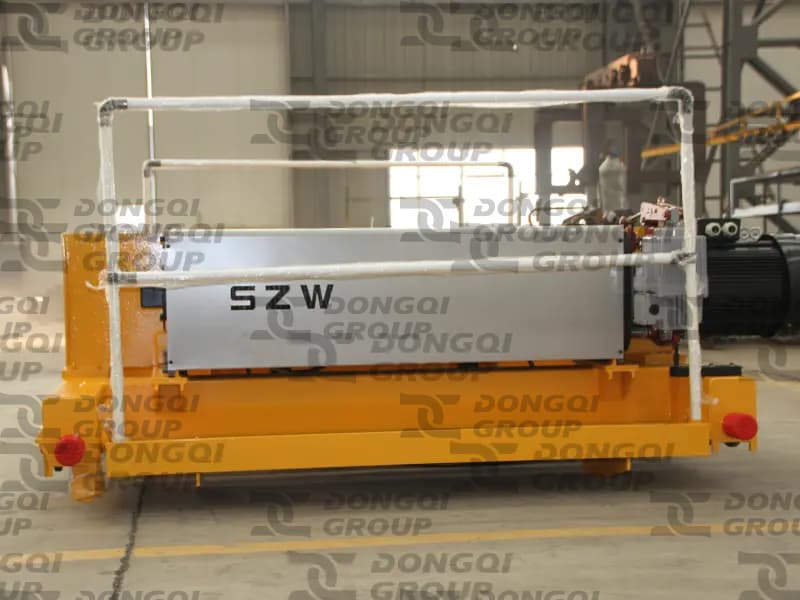
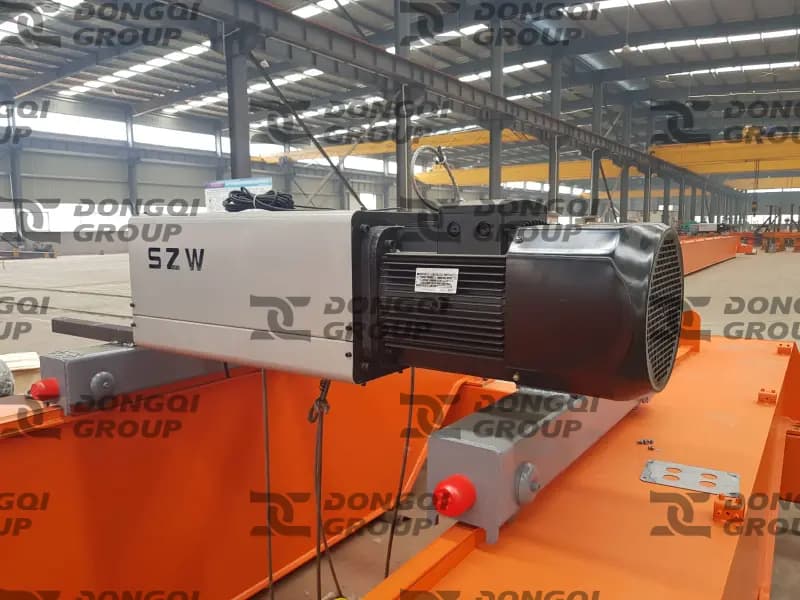
Dongqi 10t European Double Girder Crane 9m Lift Installation Sale Eritrea
$29800.00 1 set
Qingdao Shanghai
L/C T/T
New
QDX
CE, ISO9001:2000
Dongqi
General manufacturing,Metal production industry,Renewable energy industry,Paper and wood industry
Product Overview
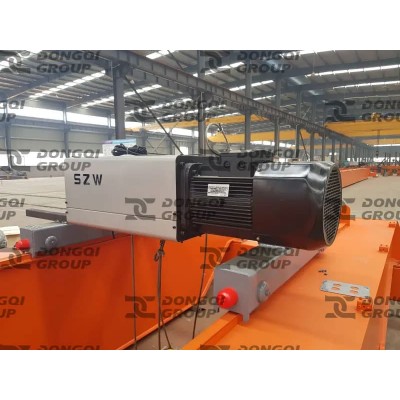
The QDX model European-spec double girder overhead crane from Dongqi Crane is a lightweight, FEM/DIN-based lifting system engineered around a single cost logic: reduce what the building has to carry, and the building itself becomes cheaper to build, heat, cool, and maintain.
Compared with traditional double girder overhead cranes, the QDX design delivers a minimum limiting distance from hook to wall and the lowest headroom in its class, allowing the crane to work closer to the front of the bay and achieve a higher lifting height within the same building envelope. The resulting increase in effective working space is not marginal—it changes what the building can do.
The more consequential advantage sits below the rails. Because the QDX crane is significantly lighter than a conventional double girder crane, wheel pressure is lower. New workshops can be designed smaller, with lighter runway beams and columns, while still performing more functions. A smaller, lighter workplace means saving a substantial amount of money from initial construction investment, and continuing to save on long-term heating, air conditioning, and structural maintenance over the life of the building.
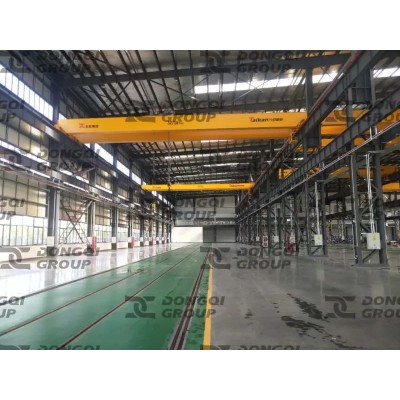
Applications include workshops, maintenance shops, warehouses, shipyards, marinas, steel mills, military facilities, and other industrial environments where headroom, hook approach, and building cost all matter.
The Building-Cost Argument: Why QDX Is Different
Most crane specifications describe the crane. The QDX specification describes the building the crane allows you to build.
Quantified lightweight performance
Compared with traditional double girder overhead cranes of similar capacity and span, the QDX European-spec design achieves the following measurable reductions:
| Metric | QDX European-Spec Advantage |
|---|---|
| Overall crane height | 20–25% lower than traditional cranes |
| Self-weight | 20–30% lighter |
| Maximum wheel load | 15–20% lower |
| Effective working space | Increased by smaller limiting dimensions and higher hook lift |
| Energy consumption | Lower, due to reduced moving mass and efficient drives |
These are not marketing estimates. They are the direct result of FEM/DIN-based structural optimization and a modular component architecture: every kilogram removed from the girder, trolley, and end carriage is a kilogram the runway and building columns do not have to carry.
What lower wheel pressure actually saves
Runway beams and building columns are sized by wheel load. A 15–20% reduction in maximum wheel pressure translates into lighter runway girders, smaller corbels, and less structural steel in the building frame. In new construction, this frequently allows a lower building height, because the crane’s own headroom is 20–25% lower. A lower building envelope reduces:
Structural steel tonnage in columns and roof framing
Foundation size and concrete volume
Cladding and roof area
Heating and air-conditioning load, permanently
Lighting volume and long-term maintenance access requirements
Dongqi’s engineering position is straightforward: the QDX crane is selected not only because it lifts the load, but because it lifts the load without forcing the building to be over-built.
Technical Specifications
| Parameter | QDX European-Spec Double Girder Overhead Crane |
|---|---|
| Product name | European-Spec Double Girder Overhead Crane |
| Model | QDX |
| Manufacturer | Dongqi Crane |
| Design standard | FEM / DIN (with ISO and IEC alignment) |
| Working class | A5 / A6 (ISO M5 / M6 equivalent), medium to heavy duty |
| Capacity | Up to 300 t (standard QDX range 5–80 t; heavier configurations engineered to order) |
| Span | 3–35 m |
| Lifting height | 6 / 9 / 12 / 15 / 18 m (custom heights available) |
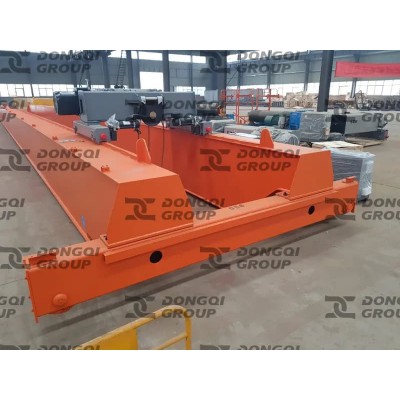
| Girder design | Double box-type welded girder |
| Power supply | 220–660 V, 50/60 Hz, 3-phase |
| Working temperature | −20 °C to +40 °C |
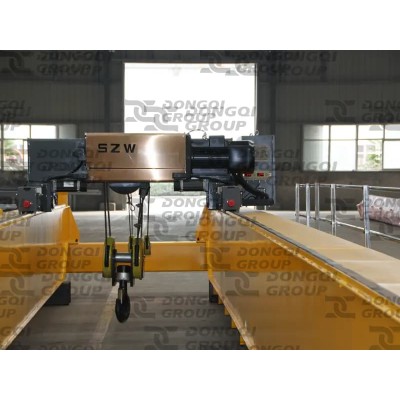
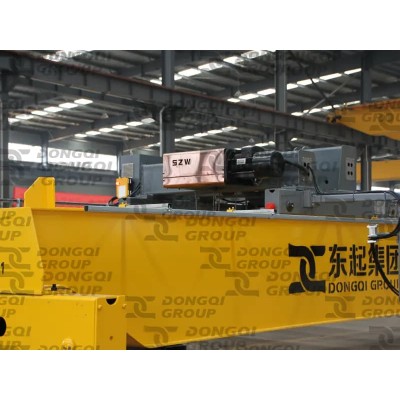
| Hoist / trolley | European-type hoist trolley, NRT double girder crab hoist, or open winch configuration depending on capacity and duty |
| Control method | Pendant, wireless remote, or cabin control |
| Travel control | VFD (variable frequency drive) on hoisting, cross travel, and long travel; stepless speed regulation |
| Lifting speed | Dual-speed or VFD stepless, e.g. 0.5/3.3 m/min, 0.8/5 m/min depending on capacity |
| Cross-travel speed | Typically 1.6–16 m/min, VFD controlled |
| Long-travel speed | Typically 2.0–20 m/min, VFD controlled |
Working class note. A5/A6 covers medium-duty through heavier general industrial service, including workshops with regular production cycling. For continuous heavy-duty or high-cycle applications, Dongqi reviews duty classification together with hoist group and wheel load rather than supplying a crane on capacity alone.
Design and Manufacturing
The QDX crane is built as a modular FEM/DIN system, with structural, mechanical, and electrical components designed as separable, interchangeable modules. This is not only a maintenance convenience—it is what makes the lightweight geometry possible without sacrificing rigidity.
Structural fabrication
Main girder: double box-type welded girder, optimized for strength, rigidity, and stability to FEM requirements.
Steel plate pretreatment: sandblasted to Sa2.5 before fabrication, removing mill scale and establishing a consistent surface for welding and coating.
Web plate cutting: CNC cutting produces smooth, accurate curved profiles, allowing the girder camber and cross-section to be optimized rather than approximated.
Welding and inspection: seams are welded by automatic arc welding and inspected by ultrasonic and X-ray testing.
Machining: girder and trolley structures are machined on floor-type boring lathes to ensure flatness and accurate interface dimensions.
Mechanical and electrical components
Motors: imported motors with insulation class F and IP54 protection, fitted with aluminium alloy stretched covers for heat dissipation.
Reducers: imported German reducers with hardened gears, high load-bearing capacity, and sealed lubrication systems.
Main electrical components: sourced from international brands such as Siemens and Schneider, with protection degree not lower than IP54.
Wheels: forged from 65Mn alloy steel, heat-treated for wear resistance, anti-fatigue performance, and long service life.
Transmission: all-in-one transmission mechanism for higher mechanical efficiency and fewer wear points.
VFD and motion performance
The QDX crane uses variable frequency control across hoisting, cross travel, and long travel. With a high-to-low speed ratio of 1:10, VFD control increases work efficiency by more than 20% compared with single-speed or conventional two-speed systems, while providing soft start/stop, reduced load swing, and precise positioning capability. This is particularly relevant for assembly, maintenance, and process applications where uncontrolled load motion creates risk or rework.
Safety and Control
The QDX crane is supplied with a safety system matched to the working duty and operating environment. Standard and available protection includes:
Traveling and lifting limit switches to prevent over-travel in all motions.
Overload protection device to prevent lifting beyond rated capacity.
Voltage-lower protection and phase-failure protection.
Emergency stop function at the operator interface.
Sound and light alarm for travel and lifting motions.
Polyurethane buffers and long-service bearings at travel extremities.
Rain cover for hoist, drives, and electrical devices, allowing outdoor configuration where required.
Optional intelligent and safety functions available on request include anti-sway control, automatic positioning, turning-over hoist, winch servicing and monitoring, and remote diagnostic tools. Dongqi’s anti-sway technology is a patented system that limits hook oscillation during travel and positioning, supporting precision handling tasks where uncontrolled swing would create risk or damage.
Control options include pendant control, wireless radio remote control, and cabin control, with VFD interface integration across all motion axes.
Configuration and Selection Guidance
The QDX platform is configured rather than ordered as a fixed catalogue item. The following application conditions help define the appropriate arrangement:
| Application condition | Recommended QDX direction |
|---|---|
| Standard double girder lifting, medium duty, capacity 5–80 t | QDX with European-type hoist trolley, A5 working class |
| Heavier duty or higher cycling | QDX with A6 classification, upgraded hoist group, VFD on all motions |
| Very heavy capacity approaching upper range | QDX open winch or NRT crab hoist configuration, reviewed against wheel load and runway capacity |
| Existing building with limited runway reserve | QDX lightweight girder, verify maximum wheel pressure with Dongqi |
| Precision positioning or assembly work | QDX with VFD + optional anti-sway / automatic positioning |
| Outdoor or partially exposed runway | QDX with rain covers and environmental protection for electricals |
| Lower building height objective | QDX low-headroom configuration, verify hook approach and lifting height against building clearance |
For any application near the capacity, span, or duty limits, Dongqi reviews crane geometry, wheel load, building clearance, and hoist group together rather than quoting a crane in isolation. The objective is a crane that fits the building as designed, or a building designed around a crane that is lighter than the conventional alternative.
Manufacturer: Dongqi Crane
Dongqi Crane designs and manufactures the QDX European-spec double girder overhead crane as an integrated FEM/DIN lifting system, covering structural fabrication, hoist and trolley supply, electrical engineering, and control configuration. Dongqi supports configuration review, wheel-load verification, runway interface checking, and the decision between a complete crane supply and a crane kit where local fabrication capacity exists. The QDX series is applied across manufacturing workshops, metallurgy, petroleum, petrochemicals, ports, railway, civil aviation, power, and other general industrial environments.
Request a Configuration
To receive a matched QDX proposal from Dongqi Crane, please provide:
Capacity required (t)
Span (m, center-to-center of runway rails)
Lifting height (m, hook travel required)
Available headroom under roof or truss
Building structure (new build or existing; runway capacity if known)
Working environment (indoor/outdoor, temperature, special atmosphere)
Duty cycle (hours per day, shifts, load spectrum)
Control preference (pendant, radio remote, cabin)
Required positioning accuracy and whether anti-sway is needed
Contact Supplier
Our Top Selling Products
LINKS : Dongqi Crane