

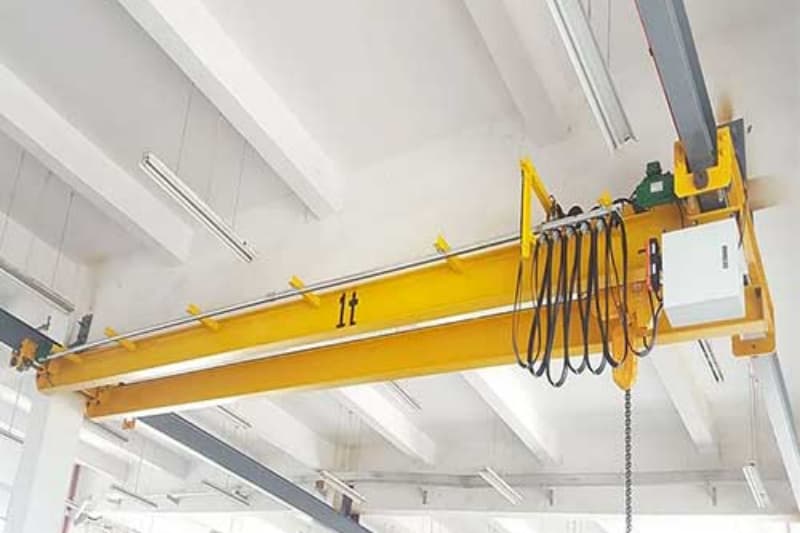
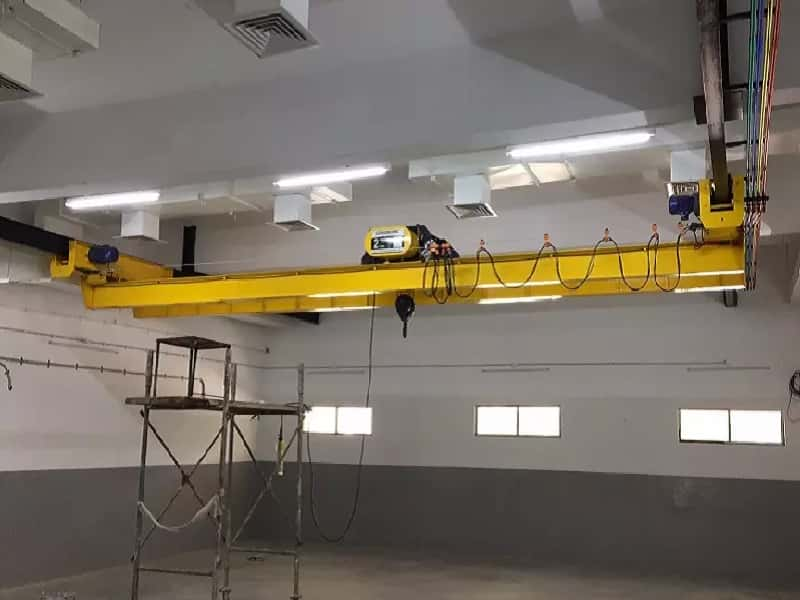
Dongqi 1t Underhung Double Girder Crane 9m Lift Assembly Sale Congo
$4185.00 1 set
Qingdao Shanghai
L/C T/T
New
NLX
CE, ISO9001:2000
Dongqi
General manufacturing,Metal production industry,Renewable energy industry,Paper and wood industry
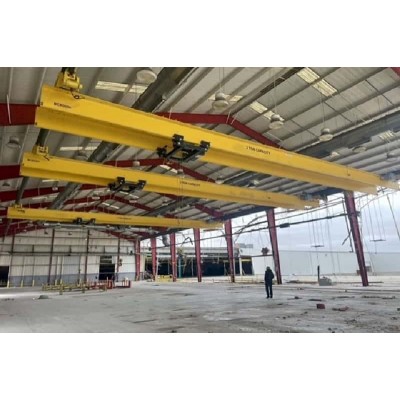
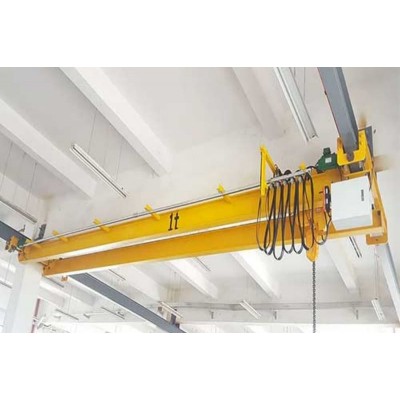
The double girder underhung overhead crane from Dongqi Crane is a suspended lifting system engineered to solve a specific building constraint: the roof is low, the floor must stay clear, and the load still needs to be lifted high. Unlike a single girder underhung crane where the hoist rides the bottom flange of one beam, the double girder configuration places the hoist trolley between two parallel bridge girders, suspended from the lower flanges or running on rails on top of the girders for maximum hook height.
The result is a crane that delivers greater lifting height, higher capacity, and enhanced stability compared with a single girder underhung design, while still hanging entirely below the runway and requiring no floor columns. The crane is designed to FEM / DIN standards, using the same ND/NR low-headroom electric hoist platform and frequency-converted three-in-one drive logic that defines Dongqi’s European-spec crane family.
This is the correct crane type for existing low-clearance workshops, roof-supported runway structures, and production areas where floor space cannot be obstructed—and where a single girder crane would either run out of capacity or leave too little hook height under the beam.
Why Double Girder Underhung: The Structural Logic
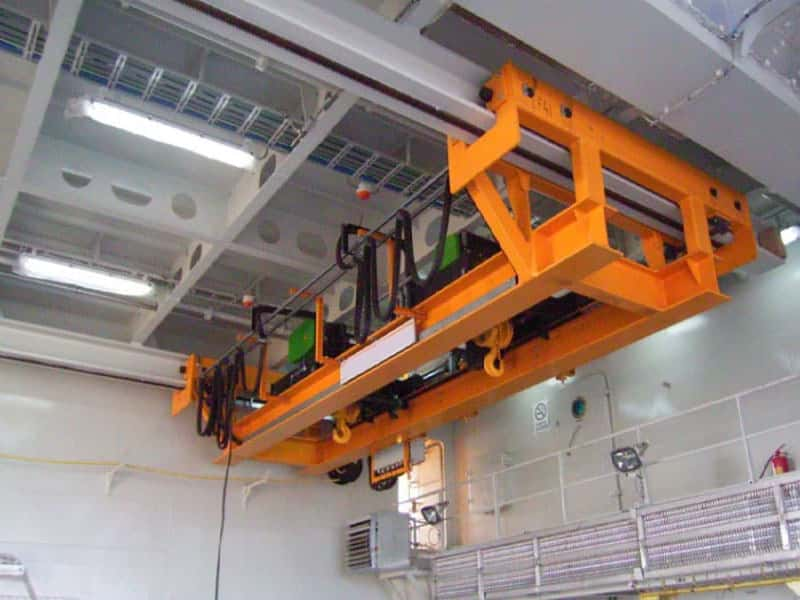
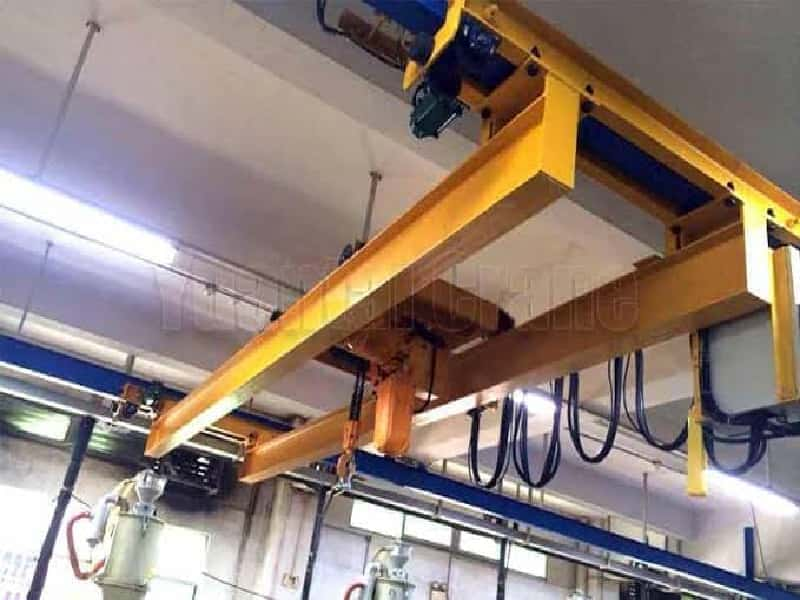
A double girder underhung crane changes where the hoist sits relative to the bridge. In a single girder underhung crane, the hoist hangs from the bottom flange of one beam, consuming vertical space below that beam. In the double girder arrangement, the hoist is carried between the two girders—either on a trolley suspended from the lower flanges, or on rails mounted on top of the girders inside the girder depth. This “notched bridge beam” geometry allows the crane to exploit the depth of the runway and girder section rather than wasting it, producing a low headroom design that maximizes hook height.
The double girder platform also carries more. A double girder underhung crane supports greater spans and heavier capacities than a single girder underhung crane of similar track configuration, while the twin-girder frame resists eccentric loading and trolley skew more effectively, giving more stable travel and positioning under load.
Technical Specifications
| Parameter | Double Girder Underhung Overhead Crane |
|---|---|
| Product name | Double Girder Underhung Overhead Crane |
| Manufacturer | Dongqi Crane |
| Design standard | FEM / DIN (ISO alignment) |
| Working class | A3–A5 / FEM 1Am–2m (light to medium duty) |
| Capacity | Up to 20 t (common configurations: 5 / 10 / 16 / 20 t) |
| Span | 3–22.5 m |
| Lifting height | 6–30 m |
| Girder design | Double box-type welded girders, connected by crossbeams |
| Lifting mechanism | ND/NR low-headroom electric wire rope hoist, mounted on double-girder trolley |
| Power supply | 220–660 V, 50/60 Hz, 3-phase |
| Working temperature | −20 °C to +40 °C |
| Control method | Pendant / wireless radio remote |
| Hoist protection | IP55, insulation class F |
| Drive | Three-in-one mechanism (motor + brake + hardened-gear reducer), VFD on all motions |
| Runway | Suspended from roof structure or overhead steelwork; no floor columns required |
Capacity note. 20 t is the upper bound of the standard underhung double girder range. Beyond this capacity, the structural depth required for underhung end carriages and runway support generally makes a top-running double girder crane more economical. Dongqi reviews the roof load capacity, runway beam size, and wheel load together for every application approaching this limit.
Design and Construction
Girder and trolley arrangement
The double girder bridge consists of two parallel box-type welded girders joined by crossbeams. The hoist trolley is positioned between the girders, with the lifting hook falling on the crane centreline rather than offset below a single beam. This geometry is what produces the additional hook height relative to a single girder underhung crane: the hook does not have to clear the depth of a beam before the load can be raised.
The end carriages run on the bottom flange of the runway beam, keeping the entire crane envelope below the track line. The runway itself can be ceiling-mounted or suspended from the building superstructure, with the option of a notched bridge beam to further reduce headroom by taking advantage of the runway’s depth.
Hoist and drive
The crane uses the ND/NR low-headroom electric hoist as its lifting mechanism, configured for double-girder trolley mounting. The ND/NR platform is designed to FEM/DIN parameters, with the low-headroom profile and large-diameter drum (NR type) that increases effective lifting height and reduces the lateral limiting dimensions of the hoist.
The drive system follows the Dongqi European-spec architecture: frequency-converted three-in-one mechanism, integrating motor, brake, and hardened-gear reducer into a compact unit. VFD control provides stepless speed regulation across hoisting, trolley travel, and long travel, with soft start/stop and reduced load swing. The silent drive characteristic of this arrangement lowers equipment noise and supports workplaces where environmental noise is a constraint.
Performance Advantages
Maximum hook height in low-headroom buildings
The between-girder trolley arrangement and the low-profile ND/NR hoist together recover vertical space that conventional single girder underhung cranes lose below the beam. In practical terms, the double girder underhung configuration typically yields greater hook height than a single girder underhung crane of comparable runway elevation, and substantially more than a top-running crane in a building where the roof cannot accommodate a runway on top of the beams.
Higher capacity and greater stability
The twin-girder frame distributes trolley and load forces across two beams, supporting heavier loads and longer spans than a single girder underhung crane. The symmetrical load path improves resistance to eccentric loading and reduces trolley skew, producing stable travel and precise positioning under load.
No floor obstructions
Because the crane runs under the roof-supported runway, no floor columns are required along the bay. Floor space remains available for production equipment, storage, and vehicle movement—an advantage that single girder and double girder underhung cranes share, and that top-running cranes cannot match where the floor must remain clear.
Energy efficiency and low noise
The integrated three-in-one drive reduces transmission losses and wear points. Frequency conversion across all motions supports smooth acceleration and energy-efficient operation, while the silent-drive arrangement contributes to low noise and environmental protection in the working area.
Safety and Protection
The double girder underhung crane is supplied with a protection set matched to the working conditions:
Overload limiter — prevents lifting beyond rated capacity.
Height limiter — limits upper and lower hook travel.
Stroke limiter — limits trolley and long-travel motion at extremities.
Photoelectric limiter — anti-collision protection between cranes on the same runway system, adjustable to the application.
Emergency stop at the operator interface.
Safety brake integrated into the three-in-one drive unit.
Crane black box (optional) — records and analyses operating data for maintenance planning and incident review, added based on customer requirements.
Control options include pendant control and wireless radio remote control, with VFD interface integration across all motion axes.
Applications
The double girder underhung overhead crane is selected where headroom is low, floor space must stay clear, and the load exceeds the comfortable range of a single girder underhung crane. Typical environments include:
Low-ceiling workshops and production halls — where a top-running crane would consume too much vertical space.
Maintenance shops and assembly areas — lifting, positioning, and equipment installation under roof-supported runways.
Warehouses and logistics facilities — handling goods in buildings with limited clearance and no floor-column tolerance.
Power stations and auxiliary buildings — maintenance lifting where overhead clearance is constrained.
Shipyards, marinas, steel mills, and military facilities — where the application requires clear floor space or multi-span coverage under an existing roof structure.
General manufacturing, machinery, metallurgy, petrochemical, railway, civil aviation, food processing, paper, building materials, and electronics — Dongqi’s underhung platforms are applied across these material handling and assembly tasks.
The crane is particularly appropriate for existing buildings with roof-supported runways, for facilities where a single girder underhung crane would be capacity-limited, and for low-clearance spaces where every millimetre of hook height matters.
Selection Guidance
| Application condition | Recommended direction |
|---|---|
| Low headroom, capacity approaching or above single girder underhung limits | Double girder underhung with ND/NR hoist between girders |
| Roof-supported runway, no floor columns permitted | Double girder underhung, verify roof load capacity |
| Need maximum hook height under a fixed low roof | Double girder underhung with notched bridge beam / between-girder trolley |
| Span or capacity beyond typical single girder underhung range | Double girder underhung, review end carriage configuration and wheel load |
| Multiple cranes on the same runway | Double girder underhung with photoelectric anti-collision limiter |
| Precision positioning / reduced load swing | VFD three-in-one drive + optional black box |
| Capacity above ~20 t or roof load inadequate | evaluate top-running double girder or alternative structural support with Dongqi |
For applications near the capacity, span, or roof-load limit, Dongqi reviews crane geometry, roof structural capacity, hoist group, and available headroom together rather than quoting a crane on capacity alone.
Manufacturer: Dongqi Crane
Dongqi Crane designs and manufactures the double girder underhung overhead crane around the ND/NR low-headroom electric hoist and the frequency-converted three-in-one drive platform, integrating the double-girder bridge, underhung end carriages, trolley, and electrical controls as a matched FEM/DIN lifting system. Dongqi supports configuration review, roof-load interface checking, hoist selection, and the decision between a complete crane supply and a crane kit where local fabrication and installation capacity exists.
Request a Configuration
To receive a matched double girder underhung crane proposal from Dongqi Crane, please provide:
Capacity required (t, up to 20 t standard)
Span (m, centre-to-centre of runway tracks)
Lifting height (m, hook travel required)
Available headroom below the roof structure or runway beam
Roof / runway support condition (existing structure, load capacity if known)
Working environment (indoor, temperature, special atmosphere)
Duty cycle (hours per day, shifts, load spectrum)
Control preference (pendant, wireless remote)
Whether the runway is existing or to be designed with the crane
Contact Supplier
Our Top Selling Products
LINKS : Dongqi Crane