


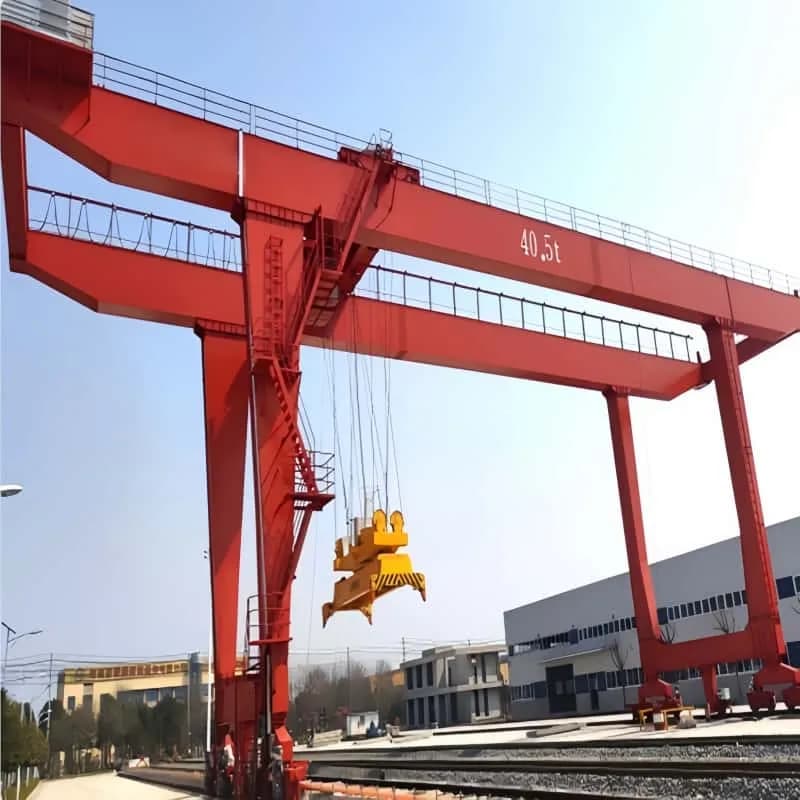
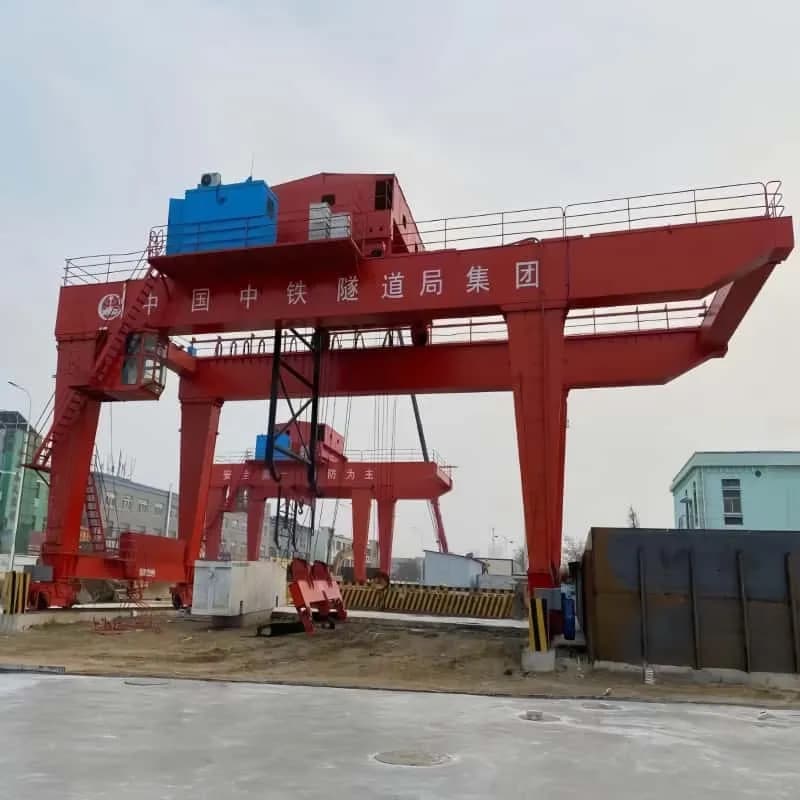
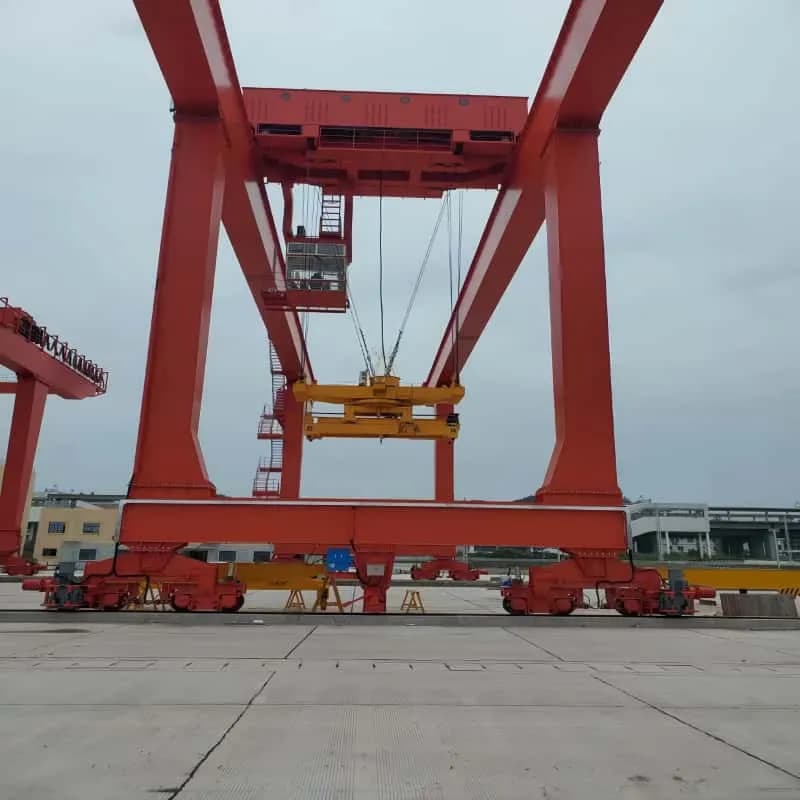
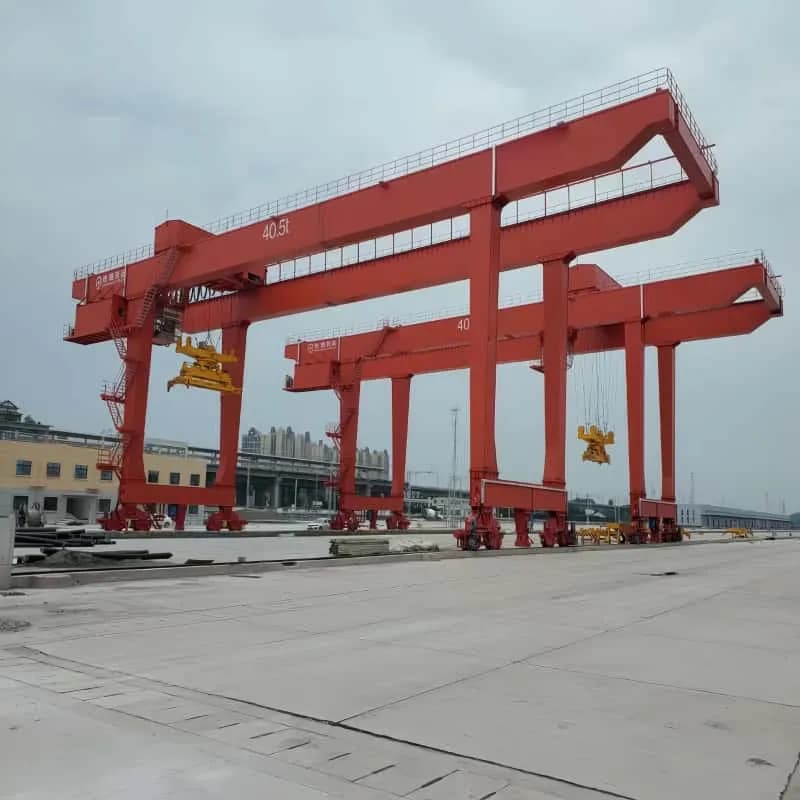
70t Rail-Mounted Container Gantry Crane 15.3m Lift 40m Span Turkey
$300000.00 1 set
Qingdao Shanghai
L/C T/T
New
RMG
CE, ISO9001:2000
Yuantai
General manufacturing,Container handling
Rail-Mounted Double Girder Gantry Crane
Rail-Mounted Gantry Cranes (RMGs) are commonly used in container yards and intermodal terminals. These cranes run on rails, which provide stability and allow for high precision in container handling. They are designed to transport containers over large areas and are often used for stacking containers in yard operations.
The RMG is capable of lifting international standard containers (20′, 40′, and 45′) with ease, thanks to its specially designed container spreader.
(1) Features
RMG container cranes are fixed on rails and are mainly used for stacking and moving containers in large container terminals. These cranes have the following advantages:
High Precision: They move along fixed paths, allowing for greater accuracy in container handling.
Efficient Use of Space: RMG container gantry cranes can be used in tightly packed yards as they do not require space for maneuvering.
Environmental Impact: Since they are electrically powered, RMG cranes produce fewer emissions compared to diesel-powered equipment, making them an environmentally friendly option.
(2) Making an Informed Purchase Decision
Before making a purchase decision, it is crucial to have a clear understanding of your workload, lift height, and other specific operational needs. Determine which type of container gantry crane you need: a rail mounted gantry crane(RMG) or a rubber tired gantry crane(RTG). Both types are commonly used in container yards and share similar functionalities, yet they differ in technical specifications, efficiency in loading and unloading, operational performance, economic factors, and automation capabilities.
RMG cranes are mounted on fixed rails, providing greater stability and higher loading and unloading efficiency, making them suitable for large terminal operations that require heavy lifting capacities. Although RMG cranes require a more substantial infrastructure investment, they often lead to lower long-term operational costs due to increased productivity and reduced maintenance needs.
On the other hand, RTG cranes are unmatched in terms of maneuverability and flexibility. They are ideal for ports and container yards with limited space.
Selecting the right type of container crane is vital for enhancing the efficiency and safety of your container handling operations. With years of professional expertise, Shanghai Hexin is equipped with a team of specialists dedicated to helping you select the most suitable lifting solution tailored to your objectives. choosing the right crane, lifting mechanisms, and components is vital. This ensures optimal operational efficiency while helping you manage costs effectively, keeping them within your budget.
If you're considering investing in a new rail-mounted container gantry crane system and require a detailed quote, or if you're seeking expert advice on the optimal lifting solution for your specific operations, don't hesitate to contact us. Our dedicated team is always on standby, ready to understand your requirements and provide tailored solutions that perfectly meet your needs.
Product Parameters
Technical Parameter
| Technical Parameter of RMG Rail Mounted Container Gantry Crane | ||||||
| Capacity | t | 30 | 35 | 40.5 | 45 | 50 |
| Span | m | 15-35 | ||||
| Lifting height | m | up to 25 | ||||
| Container | 20' 40' | 20' 40' 45' | 20' 40' 45' | 20' 40' 45' | 20' 40' 45' | |
| Work duty | A6~A8 | A6~A8 | A6~A8 | A6~A8 | A6~A8 | |
Product Structure
Understanding the Structure of a Container Gantry Crane
The structure of a container terminal gantry crane is a complex and robust system, designed to handle the demanding tasks of container transport in shipping terminals and inter-modal yards. Understanding the container gantry crane structure helps the crane users and operators optimize crane performance, reduce downtime, and maintain safe, productive operations.

Gantry Structure (Main Beams and Legs)
The gantry structure forms the framework of the crane, providing the strength and stability required to lift and move heavy containers. The main components of the gantry structure include:
Main Beams (Girders): These horizontal beams span the width of the crane and support the weight of the trolley, hoisting system, and the container being lifted. The main beams are designed to withstand significant loads, often constructed from high-strength steel.
Legs (Columns): The legs support the main beams and connect them to the ground or rail system. In a rail-mounted gantry container crane, these legs run on tracks along the length of the crane's working area. For a rubber-tired gantry container crane, the legs are equipped with rubber tires, enabling mobility within the container yard.
Trolley and Hoisting Mechanism
The trolley is a mobile platform that runs along the length of the main beams. It houses the hoisting mechanism, which is responsible for lifting and lowering containers. The hoisting mechanism includes a system of ropes, pulleys, and a motor-driven hoist drum that enables the lifting operation.
Hoist Drum and Ropes: The hoist drum winds and unwinds the steel ropes that are attached to the spreader, controlling the vertical movement of the container. High-tensile ropes are used to ensure the safety and durability of the hoisting system.
Trolley Motor: The trolley is powered by motors that allow it to move horizontally along the crane's main beams, positioning the hoist directly above the container being lifted or placed.


Spreader
The spreader is the device attached to the hoist ropes that grips and locks onto the container. It is designed with twistlocks at each corner that engage with the corner castings of the container. Depending on the container size and type, different types of spreaders are used, including:
Fixed spreaders are designed to lift containers of a specific size, typically either 20-foot or 40-foot containers.
Telescopic spreaders provide greater flexibility by adjusting their length to fit different container sizes, accommodating both 20-foot and 40-foot containers, and sometimes even 45-foot containers.
Rotating spreaders enable the rotation of containers during lifting, which is useful in situations where the container needs to be oriented in a specific direction for storage, loading onto transport vehicles, or placement within a tight space.
Crane Cabin and Control System
The crane cabin houses the operator and provides a clear view of the crane's working area, enabling precise control during container handling. The cabin is equipped with various controls and displays for managing the crane's movement, hoisting, and spreader operations.
Joystick Controls and Displays: The operator uses joysticks and other control devices to move the crane, operate the trolley, and lift or lower containers. Information about crane status, load weight, and other metrics are displayed on screens inside the cabin.


Travel Mechanism (Rail-Mounted or Rubber-Tired)
The travel mechanism allows the crane to move along the length of the container yard or terminal. Depending on the type of crane, the travel mechanism can be:
Rail-Mounted: These cranes move on rails embedded in the ground. RMG intermodal gantry cranes are often used in fixed container terminals with predefined container lanes. The movement is powered by electric motors that drive the wheels along the rails.
Rubber-Tired: RTG container cranes are equipped with rubber tires, allowing them to move freely across container yards without the need for rails. RTG cranes offer flexibility, as they can be driven to different areas of the terminal.
Power Supply System
Container handling gantry cranes require significant power to operate their hoisting, trolley, and travel mechanisms. The power supply system can be electric or diesel-driven, depending on the type of crane:
Electric-Powered Cranes:Rail-mounted gantry cranes typically use electric power supplied through cables or conductors, which is cleaner and more efficient.
Diesel-Powered Cranes:Rubber-tired gantry cranes often use diesel engines to generate power for their operations. Some RTG cranes use hybrid systems that combine diesel with electric power to reduce emissions and fuel consumption.


Safety Devices: To ensure the seamless operation of the crane and to prevent potential personal injuries or mechanical failures, our safety apparatus
goes beyond basic electric protective devices or alarm bells. It includes a comprehensive range of essential equipment, as detailed below:
1. Overload Limit Switch
2. Rubber Buffers
3. Electric Protective Devices
4. Emergency Stop System
5. Voltage Lower Protection Function
6. Current Overload Protection System
7. Rail Anchoring
8. Lifting Height Limit Device
Contact Supplier
Our Top Selling Products
LINKS : Dongqi Crane